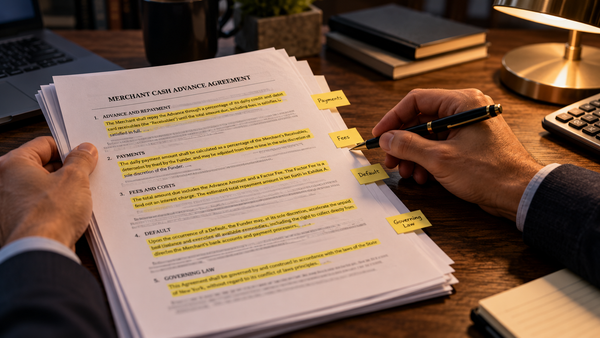
Clause by Clause: How California’s AB 2116 Will Change the Merchant Cash Advance Contract You Sign


Most coverage of California’s AB 2116 has focused on the headline: merchant cash advance funders and brokers will need a state license. That’s the big change. But for the business owner holding the contract, the more useful question is narrower: what will actually be different on the page I sign?
Governor Gavin Newsom signed AB 2116 on September 30, 2026. It brings commercial financing of $500,000 or less for small businesses under the California Financing Law. That includes merchant cash advances, factoring, and other receivables purchases. Most provisions take effect January 1, 2028, and the licensing requirement follows on July 1, 2028. For the full picture of who is covered, the exemptions, and the 2028 timeline, see this breakdown of the California AB 2116 MCA licensing law.
This guide focuses on the contract. Here is how the law affects the clauses that show up in a typical merchant cash advance agreement, based on the legal analyses published since it was signed.
The confession of judgment clause
What it is: A provision, often a separate signed document, in which the business and sometimes the owner admit in advance that they owe the full balance if they default. The funder can then file it to get a judgment without a lawsuit.
What AB 2116 changes: For covered deals, providers and brokers may not take a confession of judgment before a business defaults.
Context: California has already made judgments by confession unenforceable in its superior courts since January 1, 2023. Some funders still asked for confessions they could use elsewhere. Under AB 2116, a pre-default confession in a covered California deal becomes a violation in its own right.
The power of attorney clause
What it is: Language that authorizes the funder to sign documents or take actions on the business’s behalf, such as endorsing checks, filing liens, or dealing with customers.
What AB 2116 changes: Like confessions of judgment, a power of attorney may not be taken before a default in a covered transaction. If an agreement signed in 2028 or later grants broad authority up front, it deserves a close look.
The confidentiality clause
What it is: A term that bars the business from sharing the deal’s details with anyone. Funders have said it protects their pricing. In practice, it can make it harder for an owner to get advice or compare offers.
What AB 2116 changes: Covered agreements can’t include terms that stop a business from disclosing information from its dealings with the provider, including the product’s terms. An owner can show the contract to an accountant, an attorney, or another funder.
The pricing section
What it is: The factor rate, the purchased amount, the remittance percentage, and the fees.
What AB 2116 changes: There is no rate cap. None of the published analyses describe a limit on factor rates or APRs. The change is transparency around the deal. Brokers must post on their websites the average and maximum APR of the deals they arranged the previous year. California’s existing rules already require cost disclosures, and since January 2026 they require an APR presented in a standardized way.
What to do with it: Before signing, compare the APR on your disclosure with the broker’s posted average and maximum. An offer near the top of a broker’s range is worth asking about.
The “ability to repay” question nobody puts in writing
What it is: Merchant cash advance contracts don’t usually contain an affordability clause. Historically, a business’s capacity to handle several advances at once wasn’t the funder’s problem on paper.
What AB 2116 changes: Legal analyses of the law note that a provider’s repeated failure to consider a business’s ability to repay can be grounds for suspending or revoking its license. That doesn’t create an affordability term in your contract. It does give licensed funders a reason to underwrite more carefully. That matters most for owners being offered a second, third, or fourth advance on top of existing ones.
The whole agreement: unconscionability and unfair practices
What it is: Not a single clause, but the deal as a whole.
What AB 2116 changes: A covered transaction found unconscionable under California Civil Code § 1670.5 is treated as a violation of the Financing Law. Providers and brokers are also barred from unlawful, unfair, deceptive, or abusive acts or practices. These are broad standards. How the Department of Financial Protection and Innovation applies them will become clearer as implementation begins.
The clause that matters most: who the provider is
What it is: The party block on the first page, the entity actually providing the funds. It’s easy to skip, especially when a broker handled the whole conversation.
What AB 2116 changes: For covered agreements made from 2028 on, the contract will generally not be enforceable unless the provider is licensed, has a complete license application pending, or entered into the deal before January 1, 2028. The provider’s name and license status become some of the most important facts in the document.
What AB 2116 doesn’t change
Several standard merchant cash advance terms fall outside what the published analyses describe:
| Clause | Changed by AB 2116? |
|---|---|
| Daily or weekly ACH remittances | Not described as changed |
| Personal guarantee from the owner | Not described as changed |
| Reconciliation provisions | Not described as changed |
| UCC lien on business assets | Not described as changed |
| Forum selection and choice of law | Not described as changed |
| Factor rate or APR limits | No cap |
| Agreements signed before Jan. 1, 2028 | Outside the enforceability rule |
These terms still matter, and existing California law, including the disclosure and APR rules already in effect, continues to apply to them.
A pre-signing checklist for 2028 and beyond
- Find the provider’s legal name in the party block, separate from the broker’s name.
- Confirm the provider’s license status with the DFPI, or that an application is pending.
- Look for a confession of judgment or power of attorney to be signed at closing. Under AB 2116, neither should be taken before a default.
- Check for a confidentiality clause that limits who you can show the contract to.
- Compare the APR on your disclosure with the broker’s posted average and maximum.
- Review the clauses AB 2116 doesn’t address, especially the guarantee, reconciliation terms, and UCC lien, with an advisor.
If you already have an MCA
AB 2116 doesn’t reach agreements made before 2028, so it isn’t a reason to stop paying an existing advance. Owners dealing with a merchant cash advance dispute today still have options under California law already in effect, and those options don’t depend on the new statute.
CredibleLaw, a national legal resource and referral network, connects business owners with independent attorneys who handle merchant cash advance and business financing disputes. More information is available at https://crediblelaw.com/.
This article is general information, not legal advice. It reflects published legal analyses of AB 2116 as of October 27, 2026; regulatory guidance or amendments may affect how the law applies.