Seven Myths About Out-of-State MCA Subpoenas That Cost Business Owners Leverage

When a merchant cash advance creditor goes looking for records in another state, the rules are stranger, and often friendlier to the business, than most owners assume.
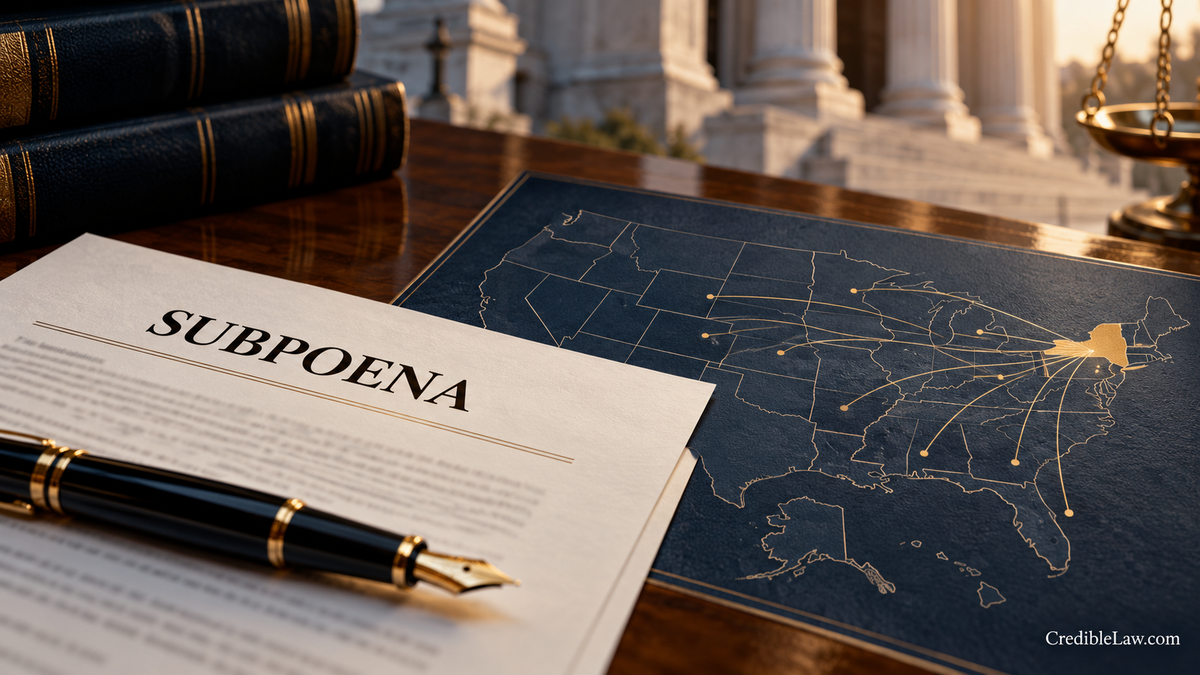
A merchant cash advance dispute rarely stays in one place. The funder is usually in New York. The business might be in Nevada, Georgia, or Oregon. The bank that holds its operating account could be headquartered somewhere else entirely, and its customers may be spread across a dozen states.
So when collection moves into the discovery phase, and the creditor starts demanding bank statements, customer lists, and sworn answers about where the money went, a practical question comes up quickly: whose rules apply when the paperwork crosses a state line?
Business owners tend to answer that question with guesses, and the guesses tend to be wrong in ways that cost them. Below are seven of the most common misconceptions, and what is actually true.
Myth 1: "If it has a court's name on it, everyone has to obey it."
A subpoena does carry the authority of the court that issued it. But that authority stops, for the most part, at the edge of that court's reach. A New York trial court can compel people and companies it has jurisdiction over. A hardware distributor in Kansas or a family-owned bank in Tennessee that has no presence in New York is not automatically one of them.
That is why an out-of-state subpoena mailed directly from New York to a business in another state is often the weakest version of the document. It may look official. It may cite New York statutes. It may even produce records if the recipient's staff simply processes it without asking questions. But its legal force outside New York is often far more limited than it appears.
Myth 2: "The creditor can just mail it and wait."
Mailing is easy. Enforcing is not. To give a subpoena real teeth against a person or business in another state, a creditor typically has to do one of a few things:
- Domesticate the subpoena by presenting it to a court clerk in the state where the records or witness are located, who then issues a local subpoena with matching terms.
- Register the judgment in the business owner's home state, turning it into a local judgment that can be enforced with local tools.
- Serve a recipient that has a genuine foothold in New York, such as a large bank that operates branches there.
- Use a federal court, where subpoenas can travel nationwide but compliance is generally limited to within 100 miles of where the recipient lives or regularly does business.
Each of those paths takes more time, more paperwork, or both. And each creates a moment where the business owner, through counsel, can push back.
Myth 3: "Once it's domesticated, it's a New York subpoena with a local stamp."
This one gets the law almost exactly backwards.
The Uniform Interstate Depositions and Discovery Act, which nearly every state has now adopted, makes domestication simple for creditors. There is no separate lawsuit and no judge needed just to issue the local subpoena. But the price of that convenience is that the local state's law takes control. Challenges to a domesticated subpoena are filed in a court in the state where discovery is happening, and that court applies its own rules about what is allowed.
A 2022 decision from Virginia shows why that matters. A creditor holding a New Jersey judgment domesticated a document subpoena in Virginia to reach bank records of third parties it suspected were sheltering the debtors' money. Virginia's Court of Appeals held that Virginia law controlled and that Virginia does not let judgment creditors demand documents from third parties on mere suspicion. The creditor needed to show the third parties actually held the debtor's property or owed the debtor money. It could not, and the subpoena was thrown out.
Not every state draws the line in the same place, but several restrict what judgment creditors can demand from third parties. Where the records sit can be as important as where the lawsuit was filed.
Myth 4: "Only the bank can object to a subpoena sent to the bank."
It is true that the bank is the one being ordered to act. But a business owner is not a bystander when the records at stake are the business's own finances or a guarantor's personal accounts. Courts generally allow a party to challenge a subpoena to someone else when the party has a real personal interest or privacy right in what is being sought, and financial records are one of the clearest examples.
Some states build that protection directly into their rules. California, for instance, requires advance notice to individuals before certain personal records, including bank records, are produced, giving them a window to object. Florida requires notice to the other parties before a document subpoena goes out to a nonparty, and recognizes a constitutional privacy interest in individuals' financial information. Those protections do not help anyone who does not know to use them.
Myth 5: "Arbitration subpoenas work just like court subpoenas."
Many merchant cash advance contracts send disputes to arbitration. It is tempting to assume an arbitrator's summons has all the power of a court order. It often does not.
The Federal Arbitration Act lets arbitrators summon witnesses to appear before them at a hearing and bring documents. Federal appeals courts covering New York, New Jersey, Pennsylvania, California, Florida, and several other states have read that language to mean arbitrators cannot force nonparties to turn over documents before a hearing. A demand for a merchant's bank records or customer files, sent ahead of any hearing in an MCA arbitration, may be vulnerable on that ground alone.
Myth 6: "A weak subpoena can safely be ignored."
This is the most dangerous myth on the list, because it takes a real advantage and throws it away.
Some deadlines are short. A New York information subpoena asks for sworn answers within seven days after it is received. Objections to a federal document subpoena are generally due within fourteen days of service. A subpoena that has been domesticated in your own state carries your own state's contempt power behind it.
And even an unenforceable subpoena can do damage when nobody responds. Large banks and processors often handle legal paperwork through high-volume compliance teams. If no one raises an objection, records may simply be produced. Once the creditor knows where the money is, the practical leverage in the dispute shifts.
The better approach is to treat every subpoena as time-sensitive, identify where it really came from, and let counsel decide whether to comply, negotiate, object, or move to quash in the correct court.
Myth 7: "The subpoena is the real problem."
Usually, the subpoena is a symptom. Behind it sits a judgment, and judgments in MCA cases are not always as sturdy as they look. Some are entered by default after service that may not hold up. Some rest on confessions of judgment, which New York has barred against non-New York residents since 2019. Some were entered by courts whose jurisdiction over an out-of-state business is open to challenge.
When a creditor registers a New York judgment in the business owner's home state, that registration is often the best opportunity to raise those problems, and the window to do it can be short. Knocking out or narrowing the judgment can make every subpoena that depends on it disappear at once. For background on the broader collection process that follows a judgment, Credible Law's overview of what MCA post-judgment discovery involves is a useful starting point.
The bottom line for business owners
Out-of-state subpoenas are not a formality, and they are not automatically binding. They sit in the middle ground where the details decide everything: who issued the paper, who received it, where the records live, whether the subpoena was domesticated, and how strong the underlying judgment really is.
Credible Law has put together a complete guide covering the six routes merchant cash advance creditors use to pull records across state lines, a state-by-state reference table, and a seven-step response plan. Business owners can find it here: how to challenge an out-of-state MCA subpoena.
For merchants facing one of these subpoenas now, Credible Law connects business owners with independent attorneys who handle interstate discovery and MCA collection disputes, at no cost to be matched. The intake team can be reached at 888-201-0441.
Additional guides on merchant cash advance defense, business litigation, and other legal topics are available at CredibleLaw.com.
Credible Law is a national legal resource and referral network, not a law firm, and does not provide legal advice. This article is for general information only. Laws differ by state and change over time; speak with a licensed attorney about your specific situation.