The Envelope That Changes Everything: Surviving the First 48 Hours After an MCA Lawsuit

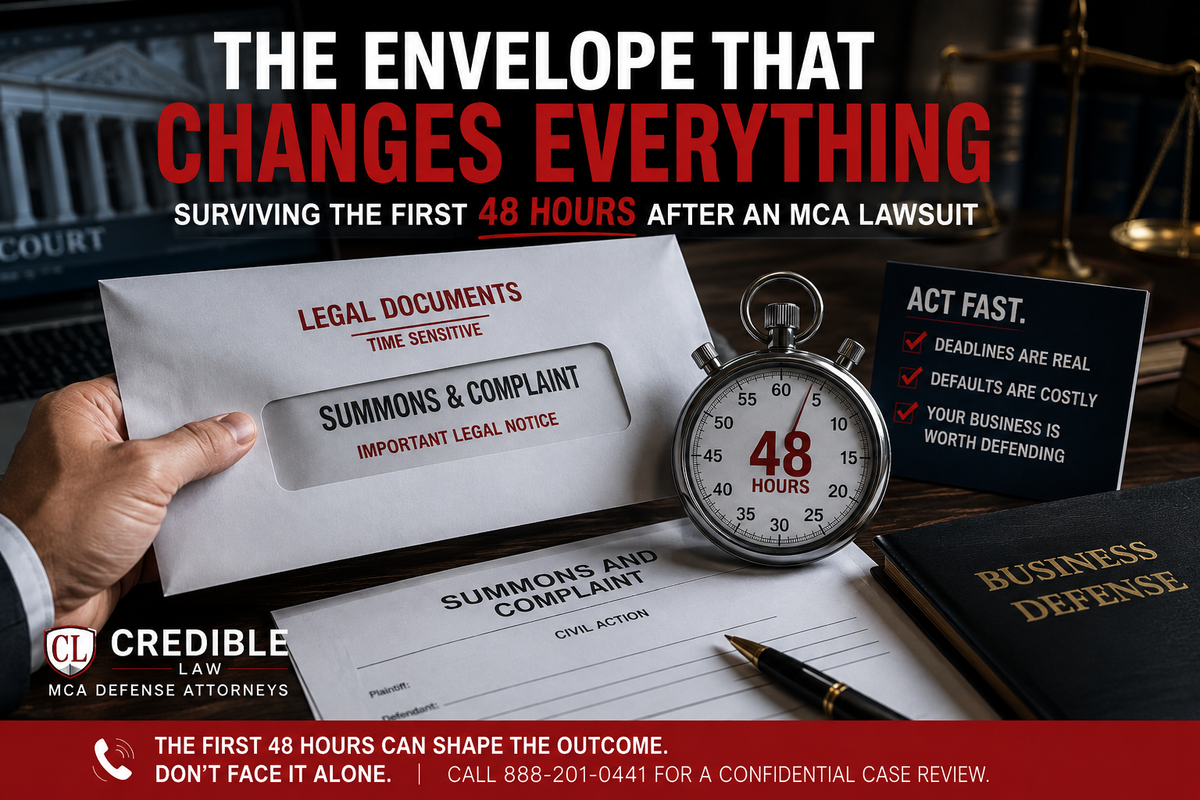
There is a specific kind of quiet that falls over a business owner when a stranger hands them a folded stack of legal papers and walks away. For a few seconds, nothing feels real. Then the words start to register — *summons*, *complaint*, the name of the merchant cash advance company that wired money into the account months ago, and underneath it all, the creeping realization that this is happening now, today, whether or not there is time for it.
If you are reading this in that state, take one breath. Then keep reading, because what you do over the next two days matters more than almost anything else that will happen in this case.
Why nobody warns you about the clock
Most business owners assume a lawsuit works the way it does on television: papers get served, lawyers argue for months, and eventually a judge decides. Merchant cash advance litigation does not work that way. It is built for speed. The funder's attorneys use standardized filings, they know exactly which courts to file in, and their entire process is designed to turn a missed payment into an enforceable judgment before the business owner has organized a response.
That compression is not an accident. It is the strategy. The less time you have to find a lawyer, read your contract, and file a proper answer, the more likely the funder wins by default rather than by actually proving its case. A default judgment — one entered simply because you did not respond in time — carries the same weight as one a judge issues after a full trial. It can be used to freeze accounts and seize funds just the same.
This is why the first 48 hours are decisive. What you do in those two days does not usually win the case outright. It determines whether you still have a case to win at all.
Hour zero: the papers are in your hand
The temptation is to set the envelope down and deal with it later. That instinct has cost more businesses than any funder ever could. The first thing to do is capture information that becomes difficult to reconstruct once the shock fades.
Write down the exact date and time you were served, and how it happened. Were you handed the papers personally? Were they left with an employee, a family member, or your registered agent? Were they posted on a door? Each method carries different legal weight, and your entire response deadline is calculated from this moment. Getting the date wrong by even a day can matter.
Do not throw away the envelope. The postmark and mailing method can become relevant if the validity of service is ever challenged, and improper service is one of the more common procedural defenses in these cases. Photograph everything — every page, the envelope, any labels.
Then read the first page carefully and find three things: the court where the case was filed, the index or docket number, and the response deadline. That deadline is now the single most important date your business has.
Hour two to twelve: figuring out how much time you actually have
Here is where a lot of owners get blindsided. Your response deadline depends on the state where the case was filed and how you were served — and merchant cash advance contracts routinely drag businesses into courts far from home. The overwhelming majority of these agreements contain a clause naming New York as the required venue, which is how a company in Arizona or Georgia ends up defending a lawsuit in Manhattan.
The windows are short and they vary. In New York, the response period is often around 20 days if you were served in-state and 30 days if served elsewhere. New Jersey commonly allows 35 days. Florida is frequently 20. But these are general ranges, not gospel — the only number that governs your situation is the one printed on your own summons. Read it, confirm it, and count backward to give yourself margin.
If your business is nowhere near the court where you were sued, that does not mean the case can be ignored. It also does not always mean the venue is valid. Those forum clauses can sometimes be challenged, but not by pretending the lawsuit does not exist.
Hour twelve to twenty-four: your money is the priority
This is the part that causes the most panic and the most misunderstanding, so it deserves a clear answer. In most states, being sued does not by itself freeze your bank account. An account freeze generally requires a judgment first, and then a restraining notice or levy served on your bank. So on the first day, being sued usually means the clock has started — not that your money is already gone.
The dangerous exception is the confession of judgment. If your contract contained one and it is enforceable against you, the funder may be able to obtain a judgment and move against your accounts far faster than an ordinary lawsuit would allow — sometimes before you fully grasp that you have been sued. This is why reading your specific contract early is not optional. A neutral resource that walks through this in plain language is the guide published by CredibleLaw on what to do in the first 48 hours after an MCA lawsuit, which lays out the hour-by-hour sequence and explains exactly where the confession-of-judgment risk fits.
Whatever you do in this window, do not empty your account in a panic. Moving money to dodge a possible freeze can create separate legal exposure, and if a restraint is already in place, transferring funds in violation of it is far more dangerous than the restraint itself. Instead, call your bank and confirm whether any legal process has actually been received. Map out which accounts hold your revenue and whether a personal guarantee could expose your personal funds.
Hour twenty-four to thirty-six: get the right help, gather the right file
By the second day, the job shifts from understanding to acting, and two things need to happen at the same time.
First, find counsel who actually defends these cases. This matters more than it sounds. A general business attorney or, worse, a debt-settlement company is not equipped for the specific mechanics of merchant cash advance litigation. Settlement companies in particular are not law firms — they cannot appear in court, challenge a restraining notice, or file the motions that protect you during the earliest and most dangerous phase.
Second, assemble your evidence file while the case is fresh. Pull together the full summons and complaint, your signed agreement and every addendum, any separate confession-of-judgment document, the personal guarantee if you signed one, and the last several months of bank statements and processing reports. Include a record of every automated debit the funder has taken. That last item can be surprisingly powerful: if your revenue dropped and the funder kept collecting a fixed amount anyway, that pattern can support arguments that reshape the entire case.
Hour thirty-six to forty-eight: choose your direction
You do not have to file your formal answer within the first 48 hours, and you should not rush a sloppy one. But by the end of the second day, you and your counsel should have a working sense of the path ahead: answering and defending on the merits, negotiating from the strength of a documented defense, or, if a judgment or freeze has already landed, moving quickly with emergency motions to undo it.
Every one of those paths depends on the same thing — that you preserved the deadline and the evidence in the first two days.
The mistakes that end businesses
Across those 48 hours, a handful of errors do more damage than anything the funder files. Assuming it is "just collections" and deciding to deal with it next month is the most common and the most fatal. Ignoring papers from a distant court because the venue seems absurd is another; a New York filing against an out-of-state business is not a glitch, it is the playbook. Blocking the automated debits or closing accounts without legal guidance can accelerate a default. And calling the funder to "work it out" alone, before anyone has reviewed your contract, can hand away defenses you did not know you had.
The reframe that helps
The papers in your hand feel like an ending. In reality they are the start of a defined process, and processes can be navigated. Business owners who move deliberately in the first two days — who capture the details, protect their accounts, and get the right eyes on the contract — routinely find that the funder's position is far less airtight than the aggressive filing suggested. The advantage the funder built on speed evaporates the moment you match it.
You did not choose this timeline. But for the next 48 hours, it is yours to use. Spend it well.
Credible Law
Law firm in San Diego, California
Address: 160 Thorn St, San Diego, CA 92103
(888) 201-0441
This article is for general informational purposes and is not legal advice. Deadlines and available defenses vary by state, court, and contract. Consult a qualified attorney about your specific situation as early as possible.