Frozen Account, Bank Levy, or Default Judgment: A Queens Owner's Guide to Merchant Cash Advance Lawsuits

Ask a Queens business owner how they found out they were being sued by a Merchant Cash Advance company, and you will rarely hear “a process server handed me papers.” Far more often, the story starts at the bank. A transfer that should have cleared didn’t. A balance that should have been there wasn’t. And somewhere in the scramble to figure out why, the words “restraining notice” or “judgment” surface for the first time.
That sequence — discovery through disruption — is the defining feature of a Queens MCA lawsuit. The legal machinery tends to run in the background until it reaches the one place a business cannot ignore: its cash. Understanding how that machinery works, and how to read the signals before it reaches your account, is what this guide is about.
A note up front: this is educational information for New York business owners, not legal advice, and nothing here creates an attorney-client relationship. Every dispute turns on its own facts.
The Mechanics of a Merchant Cash Advance Lawsuit
Start with what an MCA actually is, because the structure drives everything that follows. A Merchant Cash Advance is a working capital arrangement, typically written as a revenue purchase agreement rather than a loan. A funding company advances a lump sum, and in return it collects a share of the business’s future receipts — usually through automatic ACH withdrawals taken daily or weekly straight from the operating account.
The model works smoothly when revenue is steady. The strain shows up when sales soften or when a business is carrying more than one advance at a time. Fixed withdrawals that don’t flex with actual receipts can drain an account faster than it refills.
From a funder’s perspective, a missed or reduced payment can be treated as a default. What begins as a courtesy call escalates into demand letters from collection counsel, and from there into a filed lawsuit. The lawsuit is not the end of the road — it’s the gateway to the remedies that follow, including the bank restraints and levies that make these disputes so disruptive.
Why the Lawsuit Arrives Before the Awareness
The hardest part of MCA litigation for many Queens owners is that it advances without their knowledge. The reasons are usually mundane rather than dramatic:
• A summons sent to a prior address after the business moved
• Notices scattered across more than one Queens location
• Service that may have been improper or never genuinely reached the owner
• Critical mail lost in the volume of running a busy operation
• An owner whose attention is fully absorbed by daily operations, not legal monitoring
When a defendant doesn’t answer within the window New York allows, the funder can seek a default judgment — and the court can grant it on the basis of silence alone, never weighing whatever defenses the business might have raised. That is precisely why a frozen account so often arrives as the first news rather than the last: by then, the case has quietly progressed all the way to judgment and enforcement.
Reading the Signals Before Your Account Is Frozen
A bank freeze almost never comes out of nowhere. In hindsight, most owners can point to earlier signs they were too busy to weigh. Watch for a cluster like this:
• A rising volume of collection calls, sometimes aimed at you personally
• Correspondence from a law firm acting for the MCA company
• Fresh UCC liens recorded against the business
• ACH withdrawals that suddenly increase or shift in pattern
• Holds or unexpected changes on the merchant processing account
• Court documents — even ones delivered to an outdated address
• A formal summons and complaint opening a case
A single item might be noise. Several arriving together are a pattern, and the pattern is worth treating as a reason to review your position without delay.
Yes, a Judgment Can Reach Your Bank Account
The question every owner asks first is whether an MCA company can actually freeze the business’s money. The honest answer turns on one word: judgment. A funder can’t lock up your account simply because it’s frustrated. What it can do, once it holds a judgment, is serve a restraining notice on your bank — and the bank is then bound to hold those funds.
So the freeze you experience is the downstream effect of a court process that happened earlier and somewhere else. The money becoming unavailable is just the moment it finally becomes visible to you.
If you’re already at that point, two things move to the top of the list: understanding what to do when an MCA froze my business bank account, and learning how to unfreeze a business bank account after an MCA. Both are time-sensitive in ways that reward early attention.
What a Bank Levy Does to a Working Business
It helps to separate two terms that often blur together. A restraining notice holds funds in place. A bank levy is the step that actually pulls those held funds out to satisfy a judgment. For the business living through it, though, the label matters far less than the fallout.
The operational damage tends to land all at once:
• Payroll fails, and employees go unpaid
• Vendor and supplier payments bounce, straining relationships you depend on
• Rent, utilities, and recurring debits stop clearing
• Normal operations stall, sometimes within a single day
Picture a Queens auto shop with technicians expecting checks on Friday, or a caterer with deposits committed to a weekend event. A levy doesn’t politely wait for a convenient moment. That urgency is exactly why moving to stop an MCA bank levy is something owners address in days, not weeks — the harm accumulates with every cycle the levy stays active.
Default Judgments and Why Silence Is Costly
A default judgment is what a court enters when a sued party doesn’t respond in time. New York’s response deadlines are short, and the cost of letting one pass is steep. The circumstances behind these judgments recur in case after case:
• No response filed, frequently because notice never truly arrived
• Deadlines that elapsed before the owner grasped that a suit existed
• Genuine disputes over whether service was properly carried out
• Procedural irregularities in how the judgment was secured
Here is the more hopeful part: a default judgment isn’t necessarily the final word. Depending on the facts, a business may be able to ask the court to vacate an MCA default judgment, reopening the chance to defend on the merits. Availability depends on the specifics, timing is central, and results differ from one matter to the next.
The Quiet Damage of a UCC Lien
Tucked into many MCA agreements is the funder’s right to file a UCC-1 financing statement — a public notice claiming a security interest in business assets, often as a sweeping blanket lien over equipment, inventory, and receivables.
The consequences extend well past the immediate fight. A lien can choke off access to new financing, tie up the assets a business needs to grow, and drag down business credit. It can stand in the way of selling the company and hand the funder extra leverage at the negotiating table. For Queens owners, spotting these filings early matters, because a lien is rarely something to leave sitting — it usually has to be dealt with as part of resolving the whole dispute.
The Queens Sectors That See These Cases Most
MCA financing runs deep through the Queens economy, and a handful of industries surface repeatedly in these lawsuits:
• Restaurants and food service
• Construction firms and contractors
• Trucking and transportation operators
• Retail shops
• Auto repair businesses
• Professional services practices
• Medical and healthcare offices
• Hospitality and events businesses
The common thread is uneven revenue paired with a recurring hunger for fast capital — the very profile that draws businesses toward MCAs, and the same profile that makes rigid daily withdrawals hard to sustain when the cycle turns.
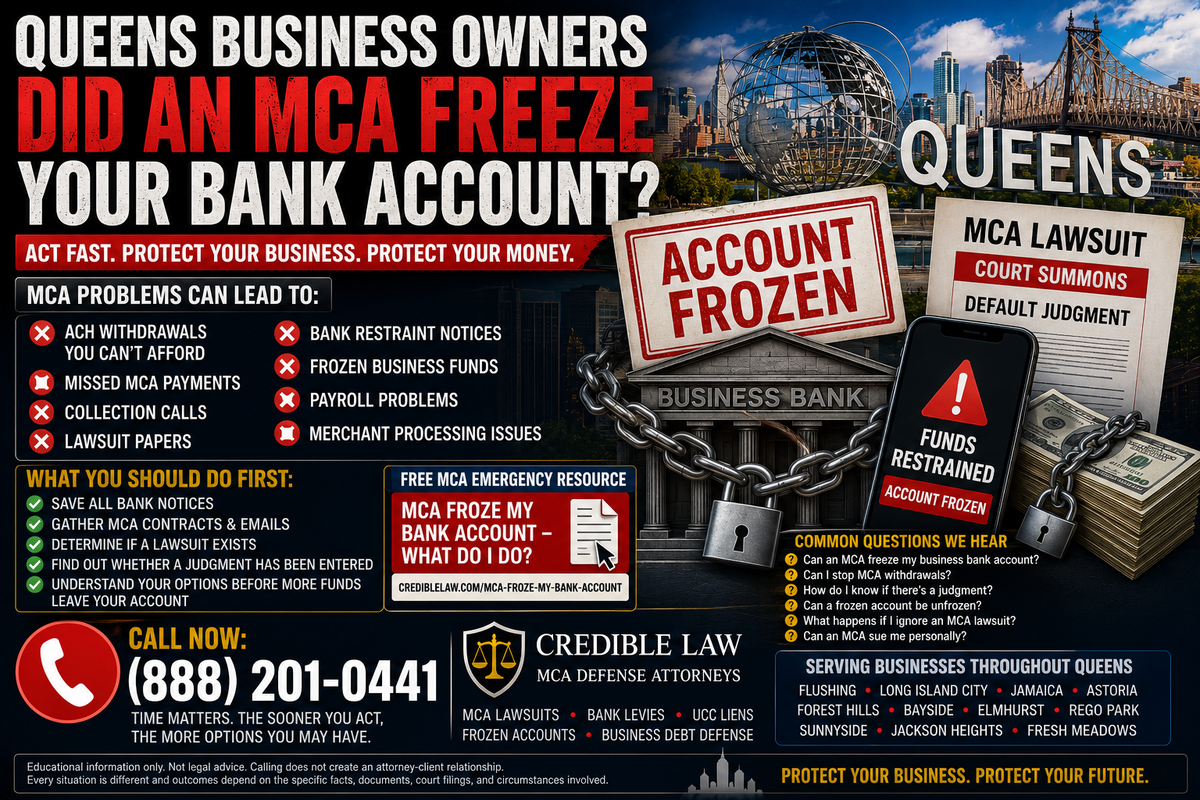
A Practical First-Response Checklist
If you’ve just learned your Queens business is facing an MCA lawsuit — or you’ve stumbled onto a frozen account or a judgment — what you do in the opening days shapes the rest. As a general, educational starting point:
• Hold on to every document tied to the advance and the dispute
• Pull together your MCA contracts, addenda, and any personal guarantee
• Export your bank records and full ACH withdrawal history
• Read any court papers closely, including any summons and complaint
• Confirm whether a judgment has already been entered against the business
• Map out the deadlines that may govern your next move
Speed is the theme. Many of the avenues that may exist — answering a suit, challenging a judgment, confronting a levy — live or die on short timelines, and they tend to shrink the longer a business waits to engage.
Common Questions From Queens Business Owners
Can an MCA company sue my business?
Yes. When a funder claims a default, it can file suit to recover what it says it’s owed. In Queens, these matters may move through the local courts, and the business generally has only a limited time to respond.
Can an MCA company come after me personally?
It’s possible. Many MCA agreements contain a personal guarantee that can let a funder pursue the owner as an individual, not just the company. Whether it applies, and how far, depends on the agreement’s terms.
Can a frozen business account be unfrozen?
Sometimes. Releasing a frozen account usually means engaging with the judgment or the enforcement process behind it. Options may exist depending on the facts, and because the funds stay locked while the issue is open, acting quickly matters.
What follows a default judgment?
A default judgment can power bank restraints and levies, UCC lien enforcement, and other collection. Since the consequences build on each other, it’s far better addressed early than left alone.
What exactly is a UCC lien?
It’s a public filing recording a security interest in business assets, often filed by MCA funders as a blanket lien. It can hurt business credit, block new financing, and complicate any sale of the business.
What if I genuinely never knew about the lawsuit?
Lack of proper notice or flawed service can carry real weight. Depending on the facts, it may support a request to set aside a default judgment. These questions are fact-specific and don’t wait well.
Can MCA withdrawals be challenged?
It depends on the agreement and the situation. There may be room to address them, but cutting off withdrawals on your own can itself trip a default clause, so it’s worth evaluating carefully first.
How can I tell whether a judgment already exists?
Reviewing your court papers, checking the relevant court records, and confirming whether any restraint or levy has hit your accounts will usually reveal whether judgment has been entered. The New York State Unified Court System offers public court information, and New York UCC filing records show liens recorded against a business.
Where Queens Owners Can Learn More
Merchant Cash Advance lawsuits don’t unfold gently. Frozen accounts, bank levies, default judgments, and UCC liens can stack into a genuine operational emergency for a Queens business. The owners who fare best are usually the ones who figure out early where the dispute actually stands — what stage it has reached, which deadlines are live, and what may still be on the table.
Credible Law maintains educational resources for New York business owners working through exactly these problems. If a Merchant Cash Advance dispute is bearing down on your Queens business, these are good places to start:
• Queens MCA Defense Attorney — MCA lawsuit defense information for Queens owners
• Queens County MCA Lawsuits — how these lawsuits proceed in Queens County
• Queens MCA Defense — an overview of Merchant Cash Advance defense considerations
It can also help to understand what a Merchant Cash Advance defense attorney does more broadly. And for general grounding on small business capital, the U.S. Small Business Administration publishes guidance on financing and lending.
These cases move fast, but the process is knowable — and recognizing where you stand is the first real step toward protecting what you’ve built.
This article offers general educational information about Merchant Cash Advance disputes involving New York businesses and is not legal advice. It does not create an attorney-client relationship. Laws and court procedures change and vary by situation, and the application of any legal principle depends on the specific facts. For guidance on your own circumstances, consult an attorney licensed in New York.