What Los Angeles Business Owners Should Know Before an MCA Lender Freezes Their Bank Account

Picture a Tuesday morning that starts like any other. A Los Angeles contractor logs into the company bank account to run payroll and finds the balance locked. Nothing clears. No warning came the day before. By the afternoon, the picture is clearer: a merchant cash advance funder obtained a judgment, served the bank, and restrained the account. The money is still there — it just can’t be touched.
Scenarios like this play out across Los Angeles every week, and they almost always trace back to the same product. A merchant cash advance, or MCA, is not a traditional loan. The funder advances cash today in exchange for a fixed slice of future revenue, collected through automatic withdrawals that hit the bank account every business day until a much larger sum is repaid. It is fast money, and for a business juggling a short-term gap it can feel like a lifeline.
The strain shows up when revenue slips. A canceled order, a seasonal lull, or a second advance taken on to cover the first, and suddenly the daily debits are larger than what the business can spare. Owners who fall behind quickly meet a cascade of pressure: aggressive collections, demand letters, lawsuits, personal guarantee claims, UCC liens recorded against the company, default judgments, and the bank levies and frozen accounts that follow. None of it is hopeless. Owners have real defenses — but the window to use them is widest before enforcement begins.
How a Frozen Account Actually Happens
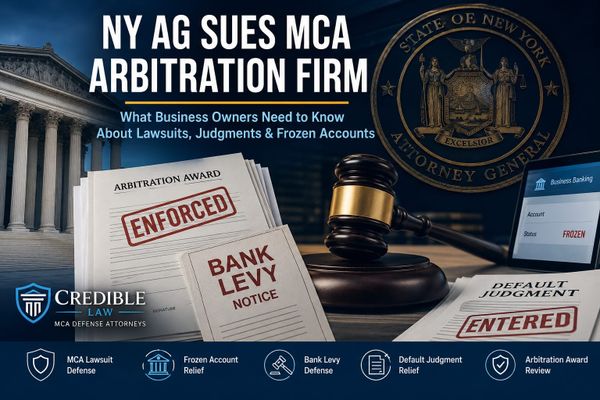
Most owners assume a bank freeze requires some dramatic court showdown. In reality it is procedural. After a funder wins a judgment — sometimes by default, when the business never answered the lawsuit — it serves the bank with a restraining notice or a levy. The bank, obligated to comply, immediately holds funds up to the amount of the claim. There is no negotiation at the teller window; the hold is automatic.
The fallout spreads within hours. Payroll fails to process, exposing the company to wage claims and risking the loss of staff. Checks to suppliers bounce, straining relationships the business depends on. Rent, insurance premiums, and tax deposits come due against a balance the owner cannot reach. A company that is otherwise viable can be pushed to the edge simply because its operating cash is locked.
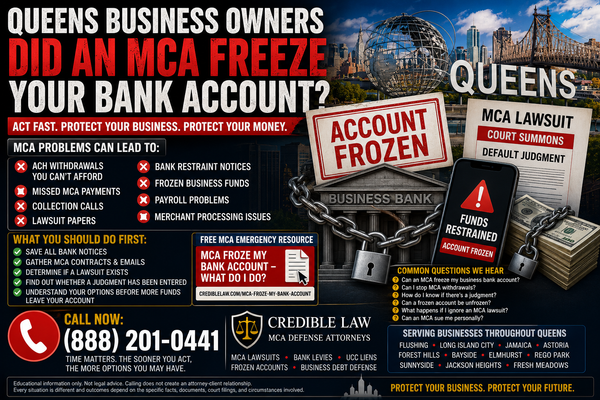
Speed is everything once a restraint hits. Depending on the facts, an attorney may be able to attack the judgment behind the levy, raise improper service, identify funds that are exempt from collection, or negotiate to release the hold while the dispute is sorted out. An owner who realizes that an MCA froze my bank account should treat it as an emergency that same day — every hour the account stays frozen deepens the operational damage and narrows the options.
The Road From Missed Payment to Judgment
A frozen account is the end of a chain, not the beginning. Tracing it backward reveals a sequence that tends to repeat itself, and recognizing the stages early gives an owner room to intervene:
• A withdrawal bounces, or the owner asks the funder to scale back the daily debit — and the funder treats it as a default.
• Reconciliation breaks down, with the owner saying payments should track actual revenue and the funder declining to adjust.
• The phone starts ringing, often relentlessly, sometimes reaching employees and business contacts.
• Formal demand letters and attorney notices arrive claiming the entire purchased amount is due now.
• A complaint is filed, frequently fast and sometimes in a courthouse nowhere near California.
• A judgment is entered — automatically, if the business missed the deadline to respond.
• Enforcement begins: account restraints, levies, and seizure of incoming revenue.
• Collection reaches beyond the company through UCC lien enforcement and personal guarantee claims.
What surprises many owners is the pace. A bank facing a troubled borrower might spend months in workout talks. An MCA funder may sue within weeks and move to restrain accounts almost as soon as a judgment posts. That compressed timeline is the strongest argument for getting legal eyes on the paperwork early rather than waiting to see what happens.
Why the Numbers Are Tighter in Los Angeles
Los Angeles is an expensive place to run a business, and that math leaves little cushion when revenue dips. The fixed costs never pause just because a daily MCA debit is draining the account. Several realities stack the deck:
• Operating costs that eat cash even during profitable stretches.
• Commercial rents among the steepest in the country.
• Heavy payroll obligations in a high-wage labor market.
• Climbing premiums for property, liability, and workers’ compensation coverage.
• A volatile economy that makes revenue hard to predict month to month.
• Sector-specific cycles that can flip a strong quarter into a shortfall overnight.
Certain Los Angeles industries feel this most acutely. Restaurants survive on slim margins and unpredictable traffic. Vendors that support film and entertainment — rental houses, catering, post-production shops — rise and fall with production schedules. Construction firms front labor and materials while waiting on progress payments. Hospitality leans on seasonal demand, transportation companies swallow fuel and maintenance costs, and medical practices wait on slow insurance reimbursements. For any of them, a daily withdrawal can be the hairline crack that spreads.
Tactics That Show Up Again and Again in MCA Suits
Once a dispute reaches court, a recognizable playbook tends to emerge. Knowing the moves makes them easier to counter:
• A summons and complaint demanding the full balance plus fees and costs.
• Forum selection clauses steering the case to a chosen court, often out of state.
• Litigation filed far from Los Angeles, raising the cost and difficulty of mounting a defense.
• Confession-of-judgment provisions in older agreements designed to bypass a defense — a practice now heavily restricted.
• The constant threat of a default judgment if the answer deadline slips.
• Lawsuits aimed at the owner personally through a signed guarantee.
• Asset investigations to locate accounts and receivables.
• Levies and revenue interception once a judgment exists.
• UCC financing statements filed to encumber the company’s assets and choke off future funding.
Consider a transportation company that took one advance, stacked a second to stay current, then disputed the debits when a major client paid late. The funder declared default, filed under a forum clause naming an out-of-state court, and won a default judgment when the owner did not grasp that a distant lawsuit still demanded a timely response — then domesticated that judgment in California to levy the account. Every link in that chain was arguable, and a Los Angeles MCA Defense Attorney can often contest the venue, the service, the balance, or the judgment itself before enforcement does lasting harm.
Why a Default Judgment Is So Dangerous — and Often Reversible
The costliest MCA outcomes usually start with a single misstep: letting the answer deadline pass. When a business does not respond to a complaint in time, the court can hand the funder a default judgment without ever examining whether the underlying claim holds up.
That silence is rarely deliberate. The suit may have landed in a faraway forum, the papers may have gone to a stale address, or service may never have genuinely reached the owner. Each of those facts can become a lever. Courts can set aside a judgment where service was defective, where the defendant has a genuine defense, or where the default stemmed from excusable neglect and the owner acted quickly to correct it.
Typical openings include challenging the amount claimed, questioning whether the funder even has the right to sue, raising contract and reconciliation defenses, and disputing how service was carried out. An owner already saddled with a judgment should look at whether it is possible to vacate MCA default judgment before enforcement begins, because reopening a case is far simpler before assets are seized than after the money is gone.
Building a Defense Under California Law
Being sued over an MCA is not a verdict — it is the start of a contest. The agreements and the way funders enforce them open several avenues an experienced advocate can pursue:
• A close read of the contract’s terms, fees, and reconciliation language.
• A choice-of-law analysis to pin down which state’s rules actually apply.
• A venue challenge questioning whether a distant court is even proper.
• Scrutiny of whether the funder honored its duty to adjust withdrawals to real revenue.
• An argument over whether the deal was a true purchase of receivables or a loan in disguise.
• Usury-related theories where a recharacterized loan could trigger interest-rate limits.
• A standing inquiry confirming the plaintiff actually holds the right to enforce.
• A review of whether collection conduct stayed within legal bounds.
• Discovery aimed at pulling the funder’s records, ACH histories, and statements.
• The settlement leverage that a credible, organized defense tends to create.
No two cases turn on the same point, and results hinge on the specific documents and facts. But mounting a substantive defense often shifts the whole negotiation. A funder that expected an easy default may suddenly find a structured, affordable resolution far more appealing than a fight.
Your First Moves When the Papers Arrive
If a lawsuit, demand letter, or levy notice shows up, the first few days carry outsized weight. A practical sequence to follow:
1. Read the papers and note the deadline immediately — it runs from the date of service, and ignoring it invites a default.
2. Lock down every record tied to the advance, the payments, and the back-and-forth.
3. Pull together the MCA contract and any stacked or related agreements.
4. Reconstruct the ACH withdrawal history to see exactly what was taken and when.
5. Save all communications with the funder and its collectors.
6. Scan recent bank activity for restraints or unexplained holds.
7. Get the documents in front of a qualified attorney to weigh defenses and deadlines.
8. File a response on time — whether answering the complaint or moving on venue or service.
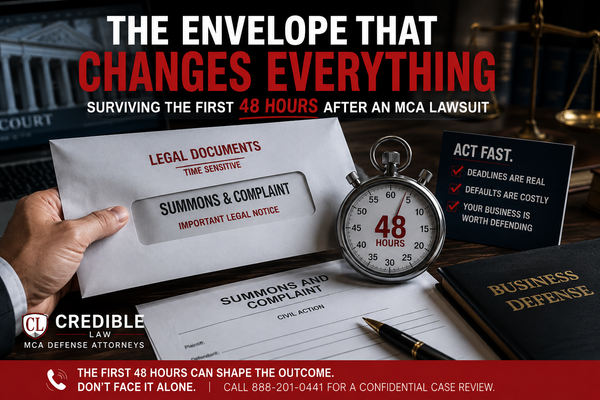
An owner who has just been served with MCA lawsuit papers should circle the response deadline as the single most important date on the calendar. Letting it pass is exactly what turns a winnable dispute into an enforceable judgment.
Settle or Fight? Reading Your Own Numbers
There is no one-size answer to whether a business should settle or litigate. The right call comes down to the dollars at stake, how strong the defenses look, and whether the company can keep its doors open through a fight. An honest weighing of cost against benefit drives the decision.
A settlement can stop the bleeding fast and preserve cash, frequently at a real discount when the owner bargains from a position of strength. Litigation earns its keep when the defenses are solid, the demand is inflated, or the funder’s standing or conduct is shaky. In practice the two blend: a believable willingness to litigate is often what produces a favorable settlement in the first place.
The calculus gets thornier with multiple or stacked advances. When several funders are chasing the same revenue stream, a single global resolution covering all of them tends to hold up better than knocking them down one at a time. Throughout, keeping the business alive is the goal — the aim is a deal the company can actually carry while it continues to operate.
Red Flags That Point to Predatory Funding
Plenty of merchant cash advances are legitimate, but certain features deserve a hard look — both when signing and when a dispute erupts:
• Effective annualized rates that dwarf what the quoted factor rate implies.
• Stacking, where funders pile on more advances than the business can realistically carry.
• Misleading promises about how reconciliation, renewals, or payoff will work.
• Fees tucked away in origination, servicing, or default clauses.
• Reconciliation language so murky the funder later refuses to apply it.
• Collection pressure aimed at the owner, the staff, or outside parties.
• Conduct that may brush up against commercial or consumer-style protections.
None of these traits automatically erases an agreement, but each can fuel a defense, sharpen negotiating leverage, and occasionally raise larger legal questions worth a careful look.
Where MCA Litigation in California Is Headed
The ground beneath merchant cash advances keeps shifting. Regulators are paying closer attention to how these products are sold and enforced, and California has broadened its commercial financing disclosure rules to give small businesses a clearer view of what they are signing up for.
Meanwhile, MCA litigation is on the rise and owners are growing savvier. More of them now treat an MCA lawsuit as something to be defended rather than quietly absorbed. Put together — sharper regulatory focus, evolving disclosures, and mounting litigation — the trend favors owners who plan ahead. Those who understand their rights before trouble strikes consistently stand on firmer ground than those who wait for the worst.
The Bottom Line
If there is one lesson running through nearly every painful MCA story, it is that timing decides outcomes. Owners who step in early — while there is still room to question the contract, challenge the venue, contest service, or negotiate from strength — fare far better than those hoping the problem dissolves on its own. Looking away almost always raises the stakes, because the funder’s next moves are a lawsuit, a judgment, and enforcement against accounts and guarantors.
Knowing the legal options before a judgment, levy, or freeze ever lands is the most valuable step a Los Angeles business owner can take. A strong position today is far easier to defend than a locked account or intercepted revenue tomorrow.
For further reading, the California Department of Financial Protection and Innovation (DFPI) administers the state’s commercial financing disclosure requirements, the California Courts website offers case lookup and self-help resources, and the California Secretary of State UCC Division maintains the registry where UCC financing statements are filed and searched.
Businesses facing Merchant Cash Advance litigation, frozen bank accounts, bank levies, or aggressive collections should understand their legal options as early as possible before collection activity escalates.
CredibleLaw is a referral network that connects business owners with attorneys experienced in MCA defense and commercial litigation. This article is for general educational purposes and is not legal advice.