The MCA Regulation Calendar: Key Dates for Small Businesses From the 2026 Midterms Through 2028

The MCA Regulation Calendar: Key Dates for Small Businesses From the 2026 Midterms Through 2028
Most coverage of the 2026 midterms is about who won. For small businesses that use merchant cash advances, a more useful question is when: when do the changes in Washington and the states actually take effect, and which dates matter for a business with an active advance?
Democrats are projected to control both the House and the Senate when the new Congress convenes, according to CBS News. That shift adds to a regulatory calendar already full of state deadlines and federal rule dates.
Here is that calendar in order, with what each date means for merchants, funders, and brokers.
Now through December 2026: the lame-duck session
The outgoing Congress stays in session until the new one is sworn in. Two items matter during this period.
Federal funding. Current government funding expires December 11, according to K&L Gates. Large must-pass spending bills sometimes carry smaller policy provisions, so watch any omnibus or stopgap bill for financial-services language.
The Subchapter V debt limit. H.R. 7730, the Bankruptcy Threshold Adjustment Act, would permanently raise the Subchapter V debt limit from $3,424,000 to $7,500,000. Subchapter V is the streamlined bankruptcy option for small businesses. The bill passed the House on September 16 and the Senate on September 28, both without recorded opposition, and it awaits the President’s action. If it becomes law, the higher limit applies only to cases filed on or after the date of enactment.
The timing matters more than usual this year. Small businesses elected Subchapter V 2,442 times in the first nine months of 2026, up 46% from the same period in 2025, according to Epiq AACER and the American Bankruptcy Institute.
December 31, 2026: the Texas registration deadline
Texas is the first state with a hard registration deadline for sales-based financing providers. Under Texas Finance Code Chapter 398, enacted through HB 700 in 2025, providers must register with the Office of Consumer Credit Commissioner by December 31, 2026.
For Texas merchants, the law also contains two provisions that apply to covered agreements regardless of registration. Confession-of-judgment provisions are void and unenforceable, and automatic debits are restricted unless the provider holds a properly perfected first-priority security interest in the merchant’s receivables.
The law gives merchants no private right of action. Enforcement belongs to the state regulator. Still, a provider’s registration status may become relevant information in a dispute.
January 2027: the new Congress convenes
This is when the election result turns into actual authority. Committee chairs become official, and with them the power to set hearings and call witnesses.
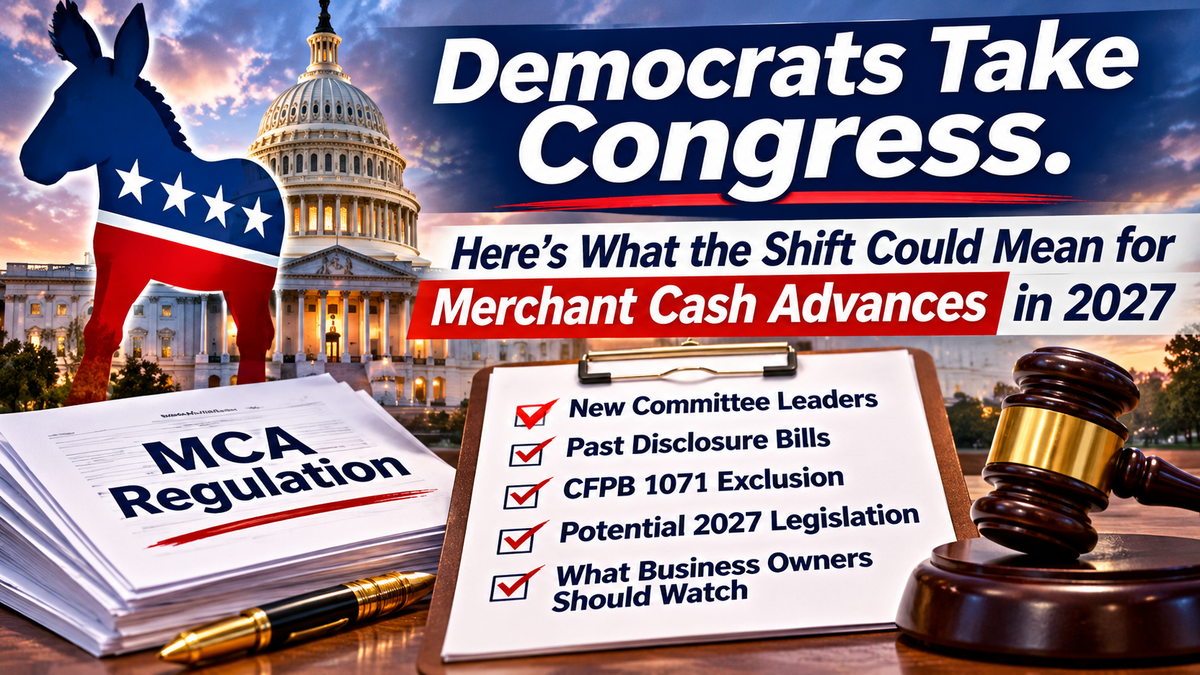
National Mortgage News reports that Sen. Elizabeth Warren is expected to chair the Senate Banking Committee and Rep. Maxine Waters the House Financial Services Committee. Both committees oversee the Consumer Financial Protection Bureau.
This doesn’t change any law on its own. What it changes is the agenda. Federal disclosure rules for small-business financing have been proposed before. The Small Business Lending Disclosure Act of 2021 would have required APR and other cost disclosures for small-business credit. A 2023 successor would have added APR disclosure for sales-based financing and given the CFPB rulemaking authority. Neither passed.
Throughout 2027: hearings, letters, and limits
Expect oversight more than legislation. The President retains the veto, and Democrats did not win a filibuster-proof Senate, so a stand-alone federal MCA law is unlikely in 2027. National Mortgage News described the outlook as limited legislation, with narrower measures most viable when attached to must-pass bills.
The activity most likely to affect the MCA industry during 2027:
- CFPB testimony. New committee leaders can call the CFPB’s director to explain the agency’s priorities, including its decision to exclude merchant cash advances from small-business lending data collection.
- Oversight letters and document requests to regulators and industry participants.
- Reintroduced disclosure bills that may not pass this Congress but shape the debate after it.
For a fuller look at the committee changes and what each could mean, Credible Law has published an analysis of how the new Congress could affect merchant cash advance regulation in 2027. It covers the earlier federal bills, the CFPB’s Section 1071 decision, and practical steps for business owners with active advances.
January 1, 2028: the CFPB Section 1071 compliance date
Section 1071 of the Dodd-Frank Act requires the CFPB to collect data on small-business lending. In May 2026, the CFPB published a revised final rule that set a uniform compliance date of January 1, 2028, narrowed the definition of a small business to $1 million or less in revenue, and excluded merchant cash advances from reporting.
The CFPB reaffirmed the MCA exclusion in October 2026. Changing it before 2028 would take new CFPB rulemaking or legislation. Hearings can apply pressure, but they can’t rewrite the rule.
2028: California’s licensing law takes effect
California has been the most active state on commercial financing. Its disclosure law, SB 1235, has applied to most offers of $500,000 or less since 2022. Since January 1, 2026, SB 362 has required APR disclosure whenever a provider quotes a rate or charge, and has barred misleading uses of “rate” and “interest.”
The next step is AB 2116, signed September 30, 2026. It brings providers of small-business commercial financing, merchant cash advances included, under the California Financing Law. Licensing phases in during 2028. The law also bars providers from taking a confession of judgment or power of attorney before default, and it limits enforcement of agreements made by unlicensed providers once it is operative.
What isn’t on the calendar: your contract
None of these dates changes an MCA agreement already signed. For a business with an active advance, the deadlines that matter most may not be on any regulatory calendar at all:
- A summons, which in many states requires a response within 20 to 30 days.
- An arbitration demand. In New York, a party served with a proper notice of intention to arbitrate generally has 20 days to apply to a court to stay the arbitration.
- An arbitration award, which in New York generally must be challenged within 90 days of delivery.
- A notice of a sister-state judgment, which in California generally must be challenged within 30 days of service.
Those deadlines run on their own schedule, regardless of who controls Congress.
How to use this calendar
For merchants, it answers a practical question: is anything coming that would change my options? For most businesses with an active MCA, the honest answer is not soon enough to plan around. The better approach is to understand the contract, know which state’s law applies, meet every deadline, and review settlement, defense, and bankruptcy options with a qualified attorney.
For funders and brokers, the calendar shows where compliance work is already required, in Texas now and California in 2028, and where more scrutiny is likely to come from in 2027.
More resources on merchant cash advance disputes, state laws, and attorney referrals are available from Credible Law, a national legal resource and attorney referral network, at https://crediblelaw.com/.
This article is general information, not legal advice. Election results and committee assignments were still being finalized at the time of writing.